Each New Year brings a fresh wave of cultural predictions about what will be IN and what will be OUT. At ACE IoT we have a few of our own. We suspect that over-the-ear headphones will be IN again and that the unexpected revival of flip phones will stay in the conversation for at least one more season. We are also hopeful that long form reading will finally be IN for real this time.
In the smart building world, our number one prediction is more than a trend: Digital Commissioning is IN for 2026.
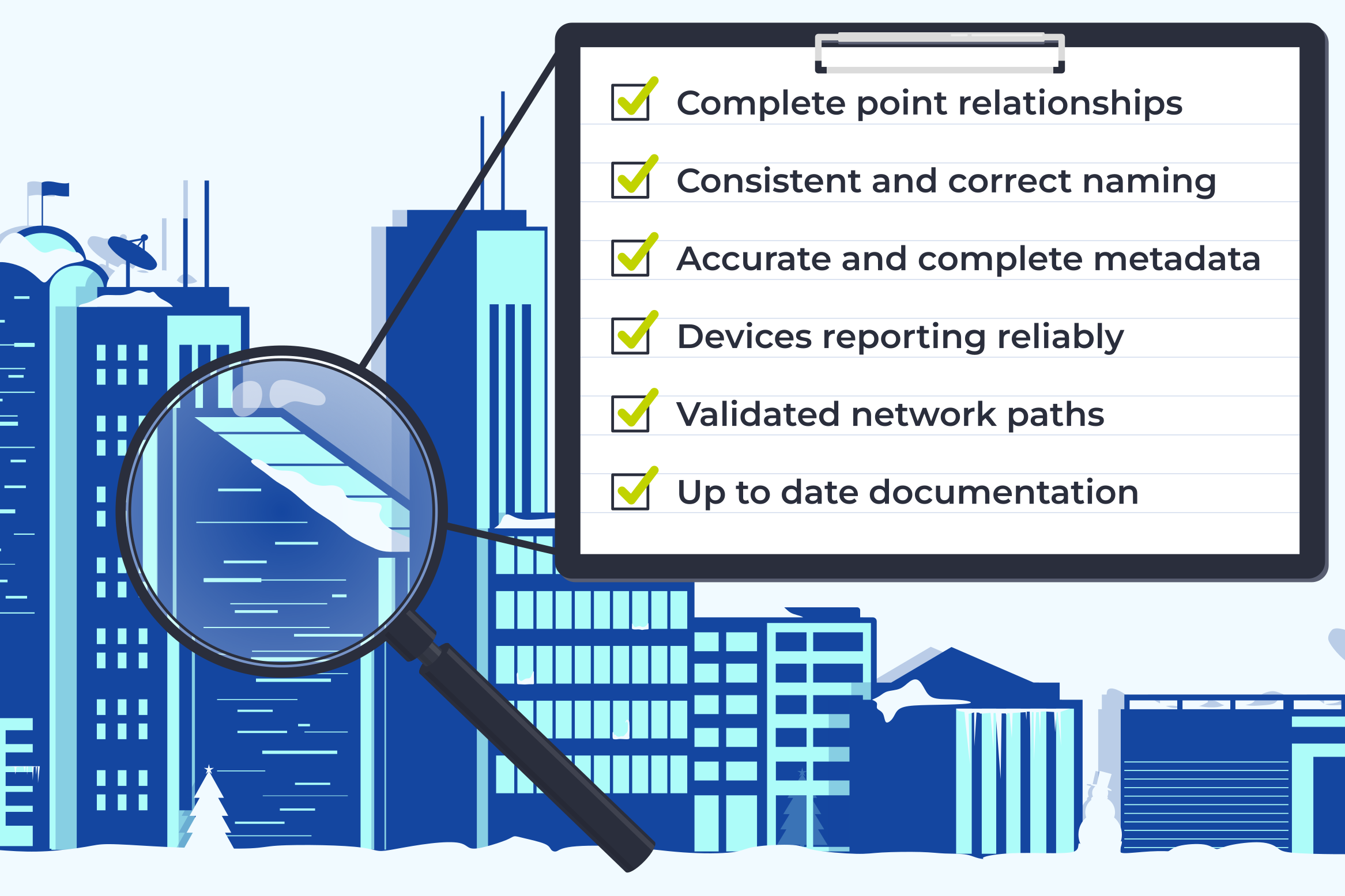
Owners want smart building capabilities that deliver meaningful insights, stronger energy performance, reliable comfort outcomes, and informed long term planning. These applications depend on healthy digital systems and trustworthy data. Many owners assume that a modern building arrives with a stable digital foundation already in place. When analytics teams begin their work, they often discover missing point relationships, inconsistent naming, incomplete documentation, and networks that were never validated. The physical systems may perform well, yet the digital infrastructure that supports analytics and automation has not received the same commissioning rigor.
This gap is where commissioning teams find themselves today. They are still expected to give owners confidence in how the building will operate, yet the digital expectations have outpaced the traditional scope. Digital Commissioning offers commissioning teams a way to expand their impact by confirming that the building’s digital infrastructure is ready for the tools and insights owners plan to use.
What Digital Commissioning Addresses
Digital Commissioning, or DCx, evaluates the digital representation of the building alongside its physical systems. DCx confirms that operational technology assets are interoperable and that their data structures follow consistent, machine readable conventions.
A complete DCx program strengthens performance across four priorities:
- Expanded Scope: DCx reviews digital interactions across all connected sub systems such as HVAC controls, lighting controls, energy meters, water meters, and any system passing data to a supervisory platform.
- Data Integrity: DCx examines naming conventions (are they applied consistently?), point structures, communication protocols, and digital documentation to confirm accuracy and completeness.
- Standardized Verification: Testing procedures follow clear, repeatable methods that apply across vendors, software platforms, and integration strategies.
- Readiness for Analytics: Systems that complete DCx are prepared to support performance analytics, optimization tools, and other modern applications.
Digital Commissioning strengthens the foundation for every system that relies on clean and accessible data.
Three Reasons Why Digital Commissioning is on ACE IoT’s IN LIST for 2026
The industry is moving quickly toward more connected, data driven operations. As buildings take on greater digital responsibilities, Digital Commissioning will shape how monitoring-based commissioning teams, engineers, and operators plan their work. Based on ACE IoT’s experience and conversations we have had with leaders in the space, three areas reflect the strongest signals from current practice and future expectations, and they are central to any honest answer to the question, “Is our OT network ready for 2026?”
1. Semantic Interoperability Will Define Digital Quality
Commissioning teams will be asked to verify not only the presence of data but the meaning behind it. This requires validating semantic models that capture equipment relationships, space associations, system hierarchies, and operational pathways in machine readable form.
A strong semantic model provides analytical tools to understand how the building functions. A semantic model also supports query based analysis, portfolio reporting, and long term asset management. Digital Commissioning will confirm that these models are complete, functional, and delivered in open formats that owners can manage independently.
2. Cybersecurity Will Become a Commissioned Responsibility
As more building systems reach the network, cybersecurity must be addressed during commissioning rather than after occupancy. Digital Commissioning will include audits of user account policies, encryption standards, segmentation strategies, and disaster recovery procedures. It will also confirm that system hardening measures are active and that responsibility for ongoing host management is clearly assigned.
3. Verified Data Will Unlock High Value Analytics
Digital Commissioning prepares the building’s Independent Data Layer to support applications such as fault detection, decarbonization planning, lifecycle analysis, and digital twin development. Verification ensures that aggregated data aligns with field values and that analytic tools inherit trustworthy information.
Commissioning teams that validate this alignment will help owners act with confidence rather than relying on assumptions about the capabilities and performance of their building’s digital assets. Verified data is what turns next year’s goals into measurable, defensible results.
Setting the DCx Foundation for 2026
Digital Commissioning gives owners confidence that their buildings can support the tools they rely on. It addresses the digital systems, network structures, and data models that shape performance in a modern facility. As the industry continues to evolve, commissioning teams that embrace digital scopes will elevate their impact and strengthen the long term value of the buildings they help deliver.
A reliable digital foundation is no longer optional. It has become an essential part of smart building practice and a necessary step before you commit to 2026 targets.
If you want to understand where your digital foundation stands or how to expand your commissioning scope, we are always ready to talk. ACE IoT can help you navigate the transition with clarity and a practical path forward.
Contact Bill Maguire at bill@aceiotsolutions.com.